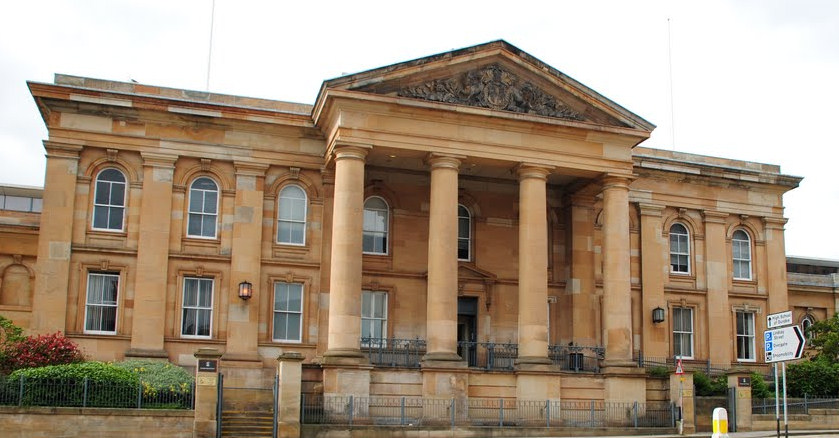
Dundee Sheriff Court Cases
This is a report of the proceedings at Dundee Sheriff Court in Bell Street,
Dundee on the morning and afternoon of 2 March 2005.
As the Accused, I took copious notes during the proceedings.
These notes, which were later accepted by the SCCRC as an accurate recording of what was said in court,
are presented verbatim, with minimal editing. Some essential narrative has been added.
Additional information is enclosed in square brackets.
The Trial was scheduled
to begin at 9am. My solicitor had not
appeared when I presented myself at Court No. 5, on the top floor, at
10:18. The Sheriff asked
if I had a solicitor and if I was adhering to my Not Guilty plea to the charge
of Dangerous Driving.
I confirmed both and
said I’d heard my solicitor was delayed on the road (it was snowy that
morning). Sheriff McCulloch said I
would be called later when he arrived.
My solicitor, Thomas
Cruickshank of George Mathers & Co., Aberdeen, arrived around 11 o’clock. We had to use a cloakroom as an interview
room. People kept coming in to collect
garments. He asked me to go over my statement about the incident, which I did. I said I had overtaken a lorry on Dundee’s
Kingsway West dual carriageway when an approaching car in the outside lane was
at least 100m away.
He remarked that in his opinion this constituted Careless Driving, a frequent theme of his.
He showed me a statement outlining what the prosecution witnesses would say in court. He had taken it down during a phone call
from the Procurator Fiscal depute (PFd) less than 24 hours earlier:
['FILE NOTE 1.3.05
Attendance on the telephone with the Procurator Fiscal Depute who will
be dealing with this case in Court 5 tomorrow at Dundee. She read from
the statements of the civilian witnesses as follows:-
Peter Carnegie says at 5.30 p.m. on the 15th June 2004 he was driving his
motor car registered number SA53 HVZ on the outer lane when he
noticed a blue Citroen on the near side lane, he remained in the outer lane
as did a motor cycle which was near to him. There was a vehicle parked
part on and part off the kerb showing hazard warning lights ahead. The
Citroen overtook on the inside and then cut out shortly causing Mr
Carnegie to brake and swerve which brought his offside wheel into
contact with the kerb in the central reservation which he inspected later
and found was damaged, he went to the police and reported the matter, he
can identify the accused. He gave the police the registration number of
motor cycle which was Y186 VMW which was nearby and would have
been witnesses and he also gave them the registration number of the car
which had caused the incident which he had noted at the time which was
SK52 DJO.
Russell Moir will say that he was on his motor cycle a Kawasaki and his
girlfriend was on the pillion her name is Katherine McGregor. He
noticed this Citroen motor car which came up behind a slow moving
vehicle and had to pull out suddenly and did so at very short notice and
with very little warning but as Mr Moir had anticipated he might do that
he was hanging back a little. Nonetheless the motor car waited until it
was a matter of feet away from the obstruction before it pulled out
simultaneously indicating. He had to break or rather he did break there
would probably not have been a collision if he hadn't broke but he
thought it as well to be sure. The vehicle then negotiated another
roundabout and then he saw the incident which was passed the round
about which involved the Vauxhall motor car. The same Citroen motor
car was on the near side lane came up to a point where there was a
vehicle half on half off the pavement with hazard warnings on either
going very slowly or stopped and at the last minute pulled out in front of
a Vauxhall which had to swerve and break violently to avoid a collision.
TC discussed with the Depute Fiscal the possibility of a Section 3 but that
is not on offer at the moment. She'll get back to us if the situation
changes and if there is any difficulty about the Trial running tomorrow.
Engaged 11.25-11.35 a.m. (10 mins)
T Cruickshank (Qual. Staff)']
The defence already had a statement by PC Kenneth Bell,
aged 41, an officer with 22 years’ service, who was stationed at Forfar Police Office.
It was not given in court because PC Bell was not required to attend.
I was not allowed to copy the statement but took notes:
[‘Went
on duty at 18:00hrs – a short time later got a call from the Forfar Office to
attend Peter Carnegie at Muirhead to take a statement – attended at 19:00hrs.
At
Locus 2 a Citroen overtook on the nearside then swerved violently into Mr
Carnegie’s path, causing him to brake and swerve and strike the kerb of the
central reservation. Examined the blue Vauxhall Astra and found a “slight scuff
mark on the front offside tyre”.
Mr
Carnegie gave him the registration mark of a witness’s vehicle. He carried out a PNC check on both
witnesses’s vehicles and subsequently noted statements from a Mr Moir and a
Miss MacGregor – both confirmed they had seen the incident and also stated that
at Locus 1 the Citroen had pulled out and caused them to brake and that later
at Locus 3 it had overtaken them on their nearside.
He
carried out a PNC check on the Citroen.
The
Locus:
1)
An unclassified road to Liff, also known as
Swallow Roundabout
2)
Near Myrekirk Road roundabout
3)
Near Strathmartine Road junction
“I did not visit the Locus”’.]
There were 3 incidents mentioned on the Complaint sheet:
[“on 15 June 2004 on a road or other public place, namely Kingsway West, Dundee, you
[the Accused] did drive a mechanically propelled motor vehicle, namely motor
car registered number SK52DJO dangerously in that, near to the junction with
Liff Road you pulled out into the path of motorcycle registered number Y186VMW,
forcing Russell William Moir to brake to avoid a collision, and near to the
junction with Myrekirk Road, you overtook motor car, registered number SV53HVZ,
on its nearside, then swerved violently into its path, forcing Peter Alexander
Gordon Carnegie to brake and swerve to av [sic] avoid a collision, causing his
vehicle to collide with the central reservation, and, near to the junction with
Strathmartine Road, you overtook motorcycle, registration mark Y186VMW, on its
nearside; contrary to the Road Traffic Act 1988, Section 2 as amended “]
[Notes on the Complaint:
The Liff Road reference appears to have been wrong - it did not match the Locus 1 in PC Bell’s statement,
which was actually the Swallow Roundabout, about 1km to the SW.
The final allegation was dropped, although the defendant was not informed of this until years after the trial.
After the trial, a clerk at my solicitors, George Mathers, amended the Complaint by scratching out the
'Liff Road' reference, replacing it with 'Muirfield Crescent'. He or she also put a line through the final allegation
and changed 'Section 2' to 'Section 3'. Why this was done was not declared]
Court No. 5 was hot and stuffy. Shortly after noon, the Accused took his place in the dock and,
while waiting for proceedings to begin, took a swig from a water bottle. Mr
Cruickshank reprimanded him, saying (correctly) that people must not drink in the dock.
Those present were the Clerk of the Court, two uniformed police officers,
a female Procurator Fiscal Depute (PFd) [whom Mr Cruickshank later described as a ‘numpty’] and a female
reporter from the Dundee Evening Telegraph. None of the participants introduced themselves to the Accused.
Sheriff Grant McCulloch entered and everyone stood up.
Mr Cruickshank introduced himself as the Defence Agent and apologised profusely
for his late arrival.
When the Clerk of the
Court asked, the Accused confirmed his name and that he was the driver.
The first witness came to the stand and took the oath.
Peter Carnegie, aged 49 [of Dalgetty Court, Muirhead], was a white-haired, robust-looking man, who looked confident.
The PFd questioned him.
He said he had the day off on the day in question and that he had joined Kingsway
West at Myrekirk Road from the Dundee side. A Gas Board van had broken down about 250
yards east of the roundabout.
The inside lane was empty but he stayed in the outside because of the van, doing 50mph
[the speed limit]. There were 2 people on a motorbike just behind him. The
Accused’s car approached from behind in the inside lane, undertook and when it
got to the broken down van, swerved into the outside lane. It was doing at
least 60mph. He braked and swerved and touched the kerb [of the central
reservation]. Later, he found a mark on the tyre, but “it was OK.” He wrote the
registration down on a bit of paper. He read it out in court using the phonetic
alphabet.
Sheriff McCulloch interjected, asking if he had written it down at the time. Mr Carnegie said he had written it down when he was about to turn off at the Strathmartine Road roundabout [about 5km further along the Kingsway].
At this point, the PFd
whispered to Mr Cruickshank: “Is it in dispute? He lost the bit of paper but found it later.” There was no response.
Carnegie said he
drove on after the collision. The Accused's car went ahead and he let it go,
returning to the nearside lane. He said the motorbike dropped back, then it
went past. He noted its registration also on the bit of paper. Then he went to Balgowan Avenue Police Station. This is near a supermarket – he was going
shopping. They took his details and
contacted him later.
The PFd then asked him to identify the Accused.
He pointed at the Accused in the dock.
The PFd then asked where he hit the central reservation.
Mr Carnegie said it was near the underpass. [This may refer to a subway at Balgarthno Terr, 400m from Myrekirk roundabout
] He said he was panicking that he
was going to hit the crash barrier and run into the gravel. He said the broken down van was a
large, doubled-wheeled Gas Board vehicle and it was parked partly on the verge. He said he was level with the van at the time of the
collision.
Sheriff McCulloch interjected again, asking if the Accused’s car would have collided with the van if it hadn’t pulled out [the answer was not recorded].
Mr Cruickshank began his cross-examination of the
witness. He passed maps to Sheriff
McCulloch and to the witness. He asked
Mr Carnegie about his use of the phonetic alphabet. “I’m a radio amateur”, he
said. He said that Denhead of Gray was
the approximate location of the incident but that it was wrongly marked on the
map he was given. [The map correctly marked Denhead of Gray to the West of the Myrekirk Road roundabout.]
Mr Cruickshank asked if the van was stopped; the witness
confirmed it.
He then suggested that the incident had taken place near a BP
filling station [about 1km E of Denhead of Gray and corresponding to Locus 2 in PC
Bell’s statement] but Mr Carnegie denied
this, saying he knew the location referred to because there was usually a
camera at that point, so he was within the speed limit. He added that he did
not have any speeding tickets.
Mr Cruickshank asked when he noticed that there were 2 people
on the motorbike. Mr Carnegie said he thought the people looked big. He said the pillion was female and looked
slight. He didn’t have any contact with
the riders. He did not know the bike from
any other time. He could not remember
the colours of their leathers.
The PFd interjected at this point, asking if this line of
questioning was necessary. Mr Cruickshank replied that it would become obvious
that it was, indeed, necessary.
He asked Mr Carnegie if, after the incident, he had ever run side by side with the Accused’s car [the answer was not recorded].
Mr Cruickshank then asked if the Accused had overtaken him.
Mr Carnegie: “Yes.”
Sheriff McCulloch interjected: “How does it pass you again if
it’s already in front of you?”
Mr Carnegie: “To be honest I was a wee
bit shocked.”
Sheriff McCulloch: “Did he or didn’t he?”
Mr Carnegie: “I think he slowed down and overtook
later.” He added that the motorbike
also passed him near the Coupar Angus flyover.
Mr Cruickshank: “I put it to you that the Accused balked you
and you tailgated him.”
Mr Carnegie: “No.”
Mr Cruickshank then asked Mr Carnegie where he thought the
Accused’s car had come from at the Myrekirk Road roundabout. The witness said he did not know.
The PFd then asked Mr Carnegie if the incident was clear in his mind.
He said he had only had the car a few months – it was his
pride and joy. He said that parts of
his memory were a bit vague – he was a bit shocked. He said he left Kingsway West at the Strathmartine Road
roundabout and the Accused’s car had gone straight on. He added that he had acknowledged the
motorcyclists as they went past.
The witness was told to stand down and he took a seat in the
public viewing area.
Russell Moir, aged 29 [from Panmure near Carnoustie],
with short-cropped hair, came to the
stand. He looked relaxed and confident.
The PFd questioned him:
He said he had travelled from Perth with his partner as
pillion on a motorbike that was now sold.
At the Swallow Roundabout [corresponding to Locus 1 in PC
Bell’s statement], the Accused was in the
slow lane when his car pulled out immediately after indicating. He braked. He said he was ready for
something like this to happen.
At the Myrekirk Road roundabout, the Citroen was in the slow
lane, which was moving faster than the outside lane. Kingsway West was busy –
it was the rush hour. He was in a queue
of traffic in the outside lane, with the Accused’s car ahead in the other lane. A white van was parked in the slow lane near
the car credit building [believed to correspond to Locus 2 in PC
Bell’s statement] with its hazard lights
on. The Citroen undertook a car in the
outside lane – “I think it was an Astra – it braked and swerved suddenly to the
right a little.” He could not tell the
registration of the Citroen.
The PFd then asked him to
identify the Accused: “I think it’s that gentleman there.”
Mr Moir went on: “The
Citroen came out to avoid hitting the van. We passed the Astra near the
underpass and I asked him if he was OK by using the thumbs up sign. He
gave a sign back. He looked shaken.”
“The Citroen passed us again on the inside near the Strathmartine Road roundabout [corresponding to Locus 3 in PC Bell’s statement]. I think he wanted to beat me.”
Sheriff McCulloch interjected: “How far short of the roundabout?”
Mr Moir replied that it
was near the turn-off to the old university playing fields – the one before
Bank Avenue, Charlotte St .
Sheriff McCulloch asked
if there was much traffic.
Mr Moir replied that it
was busy.
Sheriff McCulloch asked
if anyone else passed.
Mr Moir replied: “Folk
are always passing me on the inside.”
The PFd then asked Mr
Moir: “What was his manner of driving?”
Mr Moir replied: “He
wasn’t hanging about.”
Shortly afterwards, Mr
Moir said: “I passed him.”
Sheriff McCulloch
asked: “Later on?”
Mr Moir replied: “Just
past Clive Road.”
[on the east side of the Strathmartine Road roundabout]
Sheriff McCulloch then asked: “What do you ride?”
Mr Moir replied: “A Kawasaki 1100.”
Sheriff McCulloch raised his eyebrows and
commented: “Quite a powerful machine.”
At 13:01 the Sheriff called a lunch break. [On the resumption, Mr Cruickshank told me he had reprimanded the witnesses for talking amongst themselves in the Witness Room – something that is expressly forbidden]
The trial resumed at 14:10 with Mr Cruickshank’s
cross-examination of Mr Moir.
He established that the witness worked at Rossleigh Jaguar in Perth at
the same place as his partner. His motorbike was burgundy in colour. They both
wore white helmets and leathers with blue stripes.
Mr Cruickshank asked Mr Moir: “Are you sure you
were accompanied by your partner?”
Mr Moir replied: “Yes.”
Mr Cruickshank: “What was the cause of what
happened first? [at the
Swallow Roundabout, corresponding
to Locus 1 in PC Bell’s statement]
Could you have been in his blind spot?”
Mr Moir replied: “Maybe. He moved out to overtake
a slower-moving lorry, very close to the roundabout. There could have been an
accident.”
Mr Moir continued: “At the next roundabout
[Myrekirk Road roundabout], I saw him in a queue of traffic. He was in front in the slow lane.”
Mr Cruickshank asked where the second incident had
taken place.
Mr Moir said it was not near the BP station but
just before the Mercedes garage [corresponding
to Locus 2 in PC Bell’s statement].
Then he said it was near the BP station.
Then he said, “I’m not willing to estimate the distance.” Then he said it was opposite Dunholme Road
[roughly corresponding to Locus 2 in PC Bell’s
statement]. Then he said the parked van was 800 yards from the
Myrekirk Road roundabout, partly blocking the slow lane. He
added that the Astra swerved slightly but stayed on the carriageway.
Mr Cruickshank then
asked: “Where was the Citroen when you made that gesture to the Astra?”
Mr Moir replied: “In
front.”
Mr Cruickshank
demonstrated a pointed forefinger with thumb raised gesture and asked if he had
made such a gesture.
Mr Moir stated: “It
couldn’t be me.” He added that: “the pillion passenger sits slightly lower than
me.”
Mr Cruickshank
continued: “How did you identify the driver of the Citroen?”
Mr Moir replied: “At
the Strathmartine Road roundabout he looked over and we looked back.”
Mr Cruickshank then
asked: “Do you know witness Carnegie?”
Mr Moir replied: “No.”
He then said that they got a call from the police
a day or two later. They came round and took a statement.
Mr Cruickshank asked: “Traffic was normal – not jampacked and not empty? Do you remember any other vehicles on the road?” [the answer was not recorded]
Mr Moir went on to say that near the Strathmartine
Road roundabout he was doing about 50mph.
Sheriff McCulloch interjected: “Presumably he was
doing over 50?” and, “What speed were you doing when you were behind the
Astra?”
Mr Moir replied: “Up to 50mph.”
Sheriff McCulloch: “What speed was the Citroen doing when underpassing the Astra?” [the answer was not recorded]
Mr Moir then said that the underpass he referred to before lunch is at McAlpine Road, near Camperdown Park. It was here that he gave the Astra driver the thumbs up sign [Camperdown Park is near the Coupar Angus flyover].
The PFd concluded the interview by asking: “What
did you feel at the first incident?”
Mr Moir replied: “That he’d not seen me.”
The PFd stated: “He pulled out blindly.”
The witness was dismissed.
Catherine MacGregor, aged 30 [also from Panmure near Carnoustie], a slender, hook-nosed woman who smiled a lot, came to the stand.
She seemed nervous.
[MacGregor had given a Precognition
Statement – the only witness to do so – in early February.
Once again, I took notes from her
Statement:
About 5:30 on 15th June she was a pillion passenger on a Kawasaki ZZR 1100 motorcycle, registration number Y186 VMW, driven by Russell Moir. They were heading north on the A90. Near the junction with Liff Road she saw a pale blue Citroen Picasso in the nearside lane. Suddenly it pulled out without indicating into the offside lane, causing Russell to brake to avoid a collision. At the next roundabout the Citroen overtook a dark blue car on the nearside causing the driver to brake suddenly. At the next roundabout the Citroen was on the inside and we were in the outside lane. “Russell passed the Accused’s car at this point. I did not see it again. His driving was very erratic. The Police contacted us later. I can identify the Accused”.]
The PFd began questioning Miss MacGregor.
She said she worked at Rossleigh Jaguar in Perth
and travelled there every day from Carnoustie. She had a car, but on that day she went pillion because it was a
nice day.
She said that the first incident took place
[at the Swallow Roundabout] between 5:30 and 5:45, when the Citroen indicated
and pulled out abruptly. She could not
say if the driver looked before pulling out.
Traffic was starting to get busy – “there was a queue in front of us.”
At the second incident she could remember seeing
the Accused’s car in the inside lane. A
white van, with its hazard lights on, was taking up the full inside lane. An Astra ahead had to brake suddenly. She could not say if the Citroen driver
indicated before moving out to avoid the van.
The PFd asked what speed the Citroen was doing.
Miss MacGregor replied: “I can’t honestly say. At
least the speed limit.”
She said that if the Astra had not braked, it
would have been close to a collision.
“I got quite a fright.”
The PFd then asked her to identify the
Accused. She had a lot of trouble
pointing at the Accused in the dock and had to be asked twice more by an increasingly
irritated PFd to be more accurate. She eventually said the Accused reminded her
of someone at work.
The questioning continued and Miss MacGregor said:
“We passed it [the Citroen] again, and also the Astra,
just after the Odeon.” [believed
to be the Cineworld complex at Camperdown Park, near the Coupar Angus junction] She said Mr Moir
gestured towards the man who got cut up.
She then said: “The Citroen came up on the inside
near the Strathmartine Road roundabout [corresponding
to Locus 3 in PC Bell’s statement] and
overtook us because we were in traffic.”
She went on: “After, he undertook us again.” [on the far side of the Strathmartine Road roundabout]
Mr Cruickshank began his cross-examination of the
witness by asking: “Are you sure you were on the pillion?” and asked how she
had observed the incidents.
Miss MacGregor said: “Yes” and went on to say they were wearing similar colours of clothes and that she was slightly higher on the pillion than her partner and could easily look round him.
Mr Cruickshank then asked if the Citroen driver
might not have seen them during the first incident because of his blind spot.
Miss MacGregor replied that she would not have
thought so.
When asked about the location of the second incident,
she said it occurred 200 yards before the BP station [roughly corresponding to Locus 2 in PC Bell’s statement]. She said the white van
was definitely stationary.
Mr Cruickshank asked: “Why were you in the outside
lane at Myrekirk Road?”
Miss MacGregor responded: “Why not?”
Mr Cruickshank asked: “When did you see the
driver?”
Miss MacGregor said: “Just after the Odeon at
Baird Avenue [Baird Avenue
is an industrial area E of the Coupar Angus junction]. We drove past him
slower than 50mph.” She said they also
overtook the Astra at this point.
When asked about the gesture, she said Mr Moir got
“a thumbs up from the other chap.”
When asked about the collision, she said the Astra
might have hit the kerb but she could not be sure.
Mr Cruickshank asked the witness a question about
the Astra hitting the gravel of the central reservation.
Sheriff McCulloch interjected, telling Mr
Cruickshank that he was wrong – the Astra had not touched the gravel. Mr
Cruickshank apologised profusely. [
In fact, there is no gravel on this part of the road. There is a bevelled kerb designed to
allow wheels to ride over it without damage.]
Mr Cruickshank then asked the witness if she
thought an accident had occurred.
Miss MacGregor replied: “Yes” and that she was not
surprised to find the police involved.
The Defence Agent’s cross-examination having ended, the PFd recapped Miss MacGregor’s account.
The Accused then took the stand and was questioned
by his solicitor. He was a tall, bespectacled man, wearing a suit that seemed too tight for him.
He related that he was driving east in the inside lane of Kingsway West at around 50 mph, having just left the Myrekirk Road roundabout. The road was surprisingly quiet for the time of day, about 5:30. About 400m from the roundabout, there was a much slower vehicle – a heavily-laden small truck doing about 25mph – ahead so he looked in his mirror, noted a car more than 100m away in the outside lane, and signalled to overtake. As he began the overtaking manoeuvre, he saw that the car was much closer but judged it safe to continue overtaking because he had given ample warning of his intentions by signalling. The car came up very close behind, flashing its lights and sounding its horn. He made no response to this display of aggression and, having completed overtaking, moved back to the inside lane, still just within the speed limit. The driver then overtook, pulled sharply into the inside lane in front of him and slowed down abruptly. Realising the driver was angry, he slowed down as well, not wishing to provoke any further incident. A motorcyclist then came alongside in the outside lane and, when he was ahead of him and level with the other car, turned round in the saddle, lifted his gloved left hand from the handlebar, and pointed at the other car. The Accused was not sure what the gesture meant so ignored it. The motorcyclist then rode off and disappeared. The Accused moved out to overtake the car, but it speeded up. He resisted the temptation to exceed the limit and overtake the car and the two vehicles proceeded side by side for a time. There was no further attempt at intimidation, however. The Accused said that he eventually became aware that the car was no longer present in the inside lane and assumed it had left by a slip road. He continued his journey to Aberdeen without further incident.
Mr Cruickshank ended his questioning by asking:
“Did you make any stops when driving from Bradford?”
The Accused replied: “No.”
The PFd began questioning the Accused [this section is limited because the Accused was unable to take notes while being questioned].
She asked: “Are you saying the witnesses are
lying?”
The Accused replied: “None of the incidents took place.”
Sheriff McCulloch interjected, commenting that the
incidents described by the prosecution and the defence were so disparate that
they might have taken place on different days.
The Accused said he agreed with that.
The Sheriff went on, saying he thought the
distance from Bradford to Dundee was 250 miles.
The Accused corrected him, saying it was 275 miles.
Sheriff McCulloch asked if he had stopped for a
rest or to refuel.
The Accused said: “No”, adding that it was a
diesel car.
Sheriff McCulloch then remarked that it was a long way to drive without a stop and that the Accused might have been tired and so the obstructions on the road might not have registered. He asked if the Accused might not have seen the motorbike [at the Swallow Roundabout].
The Accused replied: “None of these incidents happened, believe me.”
The PFd then asked the
Sheriff to find all 3 witnesses credible and reliable. She invited him to convict as levelled.
The Sheriff asked what
the definition of Dangerous Driving was.
The PFd stuttered and
hesitated.
Mr Cruickshank produced
a book and showed her the definition.
He stated that Mr Moir
chose to brake and did not brake violently.
It was therefore not a Section 2a charge but Section 3.
She apologised to the
Sheriff, who said that it was not Dangerous Driving but was a Section 3 [Careless Driving] incident.
The PFd offered to
amend the charge.
Sheriff McCulloch then
formally convicted the Accused.
He asked after the Accused’s
financial circumstances.
Mr Cruickshank went
over to his client and asked him about his finances. He seemed surprised when the Accused said he was on
benefits. He declared that he would not
be paying any fine. As the solicitor
was moving away, he grabbed his gown and instructed him not to make any plea in
mitigation.
Mr Cruickshank then
approached the bench and told the Sheriff his client was on benefits and that
he needed his car “to visit an ageing relative in Bradford.”
Sheriff McCulloch then
imposed 7 points and a £300 fine to be paid at £10 per week.
The Accused handed his
driving licence to the Clerk of the Court for amendment.
The Trial ended around 4pm with Mr Cruickshank repeating his apology for his late arrival in Court.